When startled, an armadillo leaps upward. Suppose it rises 0.544 m in the first 0.2 s. (a) What is its initial speed as it leaves the ground? (b) What is its speed at the height of 0.544 m? (c) How much higher does it go? Take g = 9.8 m/s² and neglect air resistance.
Explanation
(a) Using the equation of motion: s = ut + ½at².
Take upward as positive, so a = −g.
Therefore, h = ut − ½gt².
Rearranging: u = (h + ½gt²)/t.
u = (0.544 + 0.5 × 9.8 × (0.2)²) / 0.2.
Initial speed u = 3.7 m/s.
(b) Use the equation of motion: v = u + at.
Since a = −g, v = u − gt.
v = 3.7 − (9.8 × 0.2).
Speed at 0.544 m = 1.74 m/s upward.
(c) At the maximum height, the vertical velocity becomes zero.
Use v² = u² + 2as for the remaining upward motion.
With acceleration = −g and final velocity = 0:
0 = v² − 2gΔh.
Therefore, Δh = v²/(2g).
Δh = (1.74)² / (2 × 9.8).
Additional height = 0.154 m.
✓
Conclusion
(a) Initial launch speed = 3.7 m/s. (b) Speed at 0.544 m = 1.74 m/s upward. (c) It rises another 0.154 m, reaching a maximum height of 0.698 m above the ground.
2
A ball is thrown vertically upward from ground level and reaches a maximum height of 50 m. (a) With what initial speed must it be thrown? (b) How long will it remain in the air before returning to the ground? (c) Describe the graphs of vertical position y, velocity v, and acceleration a versus time t, indicating the time when the ball reaches 50 m. Take g = 9.8 m/s² and neglect air resistance.
Explanation
(a) At maximum height, the final vertical velocity is zero.
Using the equation of motion v² = u² − 2gH:
0 = u² − 2gH.
u = √(2gH).
u = √(2 × 9.8 × 50) = 31.3 m/s.
(b) Use the equation of motion v = u − gt.
At maximum height, v = 0, so the time to rise is t_up = u/g.
t_up = 31.3/9.8 = 3.19 s.
For a ball returning to its original height, the descent time equals the ascent time.
Total time in air T = 2t_up = 6.39 s.
(c) Position versus time: y = ut − ½gt². This is a downward-opening parabola.
The maximum height of 50 m occurs at t = 3.19 s.
Velocity versus time: v = u − gt. This is a straight line with slope −g.
The velocity is zero at t = 3.19 s and equals −31.3 m/s at t = 6.39 s.
Acceleration versus time: a = −g = −9.8 m/s² throughout the flight, so the graph is a horizontal line below zero.
✓
Conclusion
(a) Initial speed = 31.3 m/s upward. (b) Total time in air = 6.39 s. (c) At t = 3.19 s, the ball reaches its maximum height of 50 m; acceleration remains constant at −9.8 m/s².
3
Raindrops fall 1700 m from a cloud to the ground. (a) If they were not slowed by air resistance, how fast would the drops be moving when they struck the ground? (b) Would it be safe to walk outside during a rainstorm? Take g = 9.8 m/s².
Explanation
(a) Assume the raindrops start from rest.
Initial velocity u = 0 m/s.
Displacement h = 1700 m downward.
Using the equation of motion: v² = u² + 2gh.
v² = 0² + 2 × 9.8 × 1700.
v = √(9.8 × 2 × 1700) = 182.54 m/s.
Converting to km/h: v = 182.54 × 3.6 = 657.14 km/h.
(b) This calculated speed assumes there is no air resistance.
In reality, air resistance opposes the motion of falling raindrops.
Raindrops typically approach a much lower terminal velocity, depending on their size and shape.
Therefore, ordinary rain is generally safe to walk in, although storms can involve lightning, strong winds, hail, and flooding.
✓
Conclusion
(a) Without air resistance, the raindrops would reach approximately 182.54 m/s (657.14 km/h). (b) In reality, air resistance greatly reduces their speed, so ordinary rain is generally safe; thunderstorms and severe weather can still be dangerous.
4
At a construction site, a pipe wrench strikes the ground with a speed of 24 m/s after being inadvertently dropped. (a) From what height was it dropped? (b) How long was it falling? (c) Describe the graphs of vertical position y, velocity v, and acceleration a versus time t. Take g = 9.8 m/s² and neglect air resistance.
Explanation
Take upward as positive and set the ground at y = 0.
Since the wrench is dropped from rest, its initial velocity u = 0.
Its acceleration is a = −g = −9.8 m/s².
(a) Using the equation of motion v² = u² + 2as:
The displacement from the release point to the ground is −h.
Therefore, v² = 0 + 2(−g)(−h) = 2gh.
h = v²/(2g).
h = (24)² / (2 × 9.8) = 29.39 m.
(b) Using the equation of motion v = u + at:
Taking downward speed as positive for this calculation, v = gt.
t = v/g.
t = 24/9.8 = 2.45 s.
(c) Position versus time: y = h − ½gt², a downward-opening parabola that starts at y = h and ends at y = 0.
Velocity versus time: v = −gt, a straight line starting at zero and decreasing to −24 m/s.
Acceleration versus time: a = −9.8 m/s², a horizontal line below zero throughout the fall.
✓
Conclusion
(a) The wrench was dropped from approximately 29.39 m. (b) It fell for approximately 2.45 s. (c) Its position graph is parabolic, its velocity graph is linear, and its acceleration graph is a constant negative horizontal line.
5
A stone is thrown vertically downward with an initial speed of 12 m/s from the roof of a building 30 m above the ground. (a) How long does it take the stone to reach the ground? (b) What is its speed at impact? Take g = 9.8 m/s² and neglect air resistance.
Explanation
Take downward as the positive direction.
Initial velocity u = 12 m/s.
Displacement s = 30 m.
Acceleration a = 9.8 m/s².
(a) Using the equation of motion: s = ut + ½gt².
30 = 12t + ½ × 9.8 × t².
Rearranging: 4.9t² + 12t − 30 = 0.
Using the quadratic formula and selecting the positive root:
t = (−u + √(u² + 2gh))/g.
t = (−12 + √(12² + 2 × 9.8 × 30))/9.8.
Time to reach the ground = 1.54 s.
(b) Using the equation of motion: v = u + gt.
v = 12 + 9.8 × 1.54.
Impact speed = 27.06 m/s downward.
✓
Conclusion
(a) The stone takes approximately 1.54 s to reach the ground. (b) Its impact speed is approximately 27.06 m/s.
6
A hot-air balloon is ascending at 12 m/s and is 80 m above the ground when a package is dropped over the side. (a) How long does the package take to reach the ground? (b) With what speed does it hit the ground? Take g = 9.8 m/s² and neglect air resistance.
Explanation
When the package is released, it retains the balloon’s upward velocity.
Take upward as positive.
Initial velocity u = +12 m/s.
Initial height h = 80 m.
Acceleration a = −9.8 m/s².
(a) Use the equation of motion: y = h + ut − ½gt².
At the ground, y = 0.
0 = 80 + 12t − ½ × 9.8 × t².
Rearranging: ½gt² − ut − h = 0.
Using the quadratic formula, choose the positive root:
t = (u + √(u² + 2gh))/g.
t = (12 + √(12² + 2 × 9.8 × 80)) / 9.8.
Time to reach the ground = 5.45 s.
(b) Use the equation of motion: v = u − gt.
v = 12 − (9.8 × 5.45).
The velocity is negative, indicating downward motion.
Impact speed = 41.38 m/s.
✓
Conclusion
(a) The package takes approximately 5.45 s to reach the ground. (b) It hits the ground at approximately 41.38 m/s downward.
7
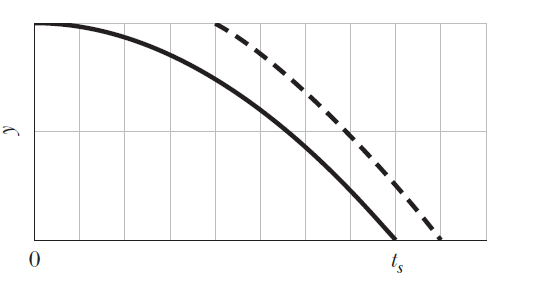
At time t = 0, apple 1 is dropped from a bridge. Later, apple 2 is thrown downward from the same height. The graph shows their vertical positions versus time until both hit the roadway. The time scale is t_s = 2 s. Estimate the initial speed with which apple 2 is thrown downward.
Explanation
Apple 1 is dropped from rest and hits the roadway at t_s = 2.0 s.
Using the equation of motion: H = ½gt_s².
H = ½ × 9.8 × (2)² = 19.6 m.
From the graph, estimate apple 2 starts at about 0.6t_s and hits the ground at about 1.2t_s.
Estimated delay = 1.2 s.
Estimated total time for apple 2 to fall = 1.2 s.
For apple 2, taking downward as positive: H = u₂t + ½gt².
Rearrange to find the initial speed: u₂ = (H − ½gt²)/t.
Substituting the estimated graph times gives u₂ ≈ 10.45 m/s downward.
The graph provides approximate times, so the answer is an estimate.
✓
Conclusion
Based on the approximate times read from the graph, apple 2 is thrown downward at about 10.45 m/s.
8
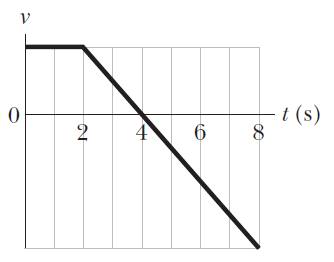
A runaway scientific balloon ascends at 19.6 m/s. At t = 2 s, an instrument package breaks free and falls under gravity. The velocity-time graph shows that the package reaches maximum height at approximately t = 4 s and reaches the ground at t = 8 s. (a) What maximum height does it rise above the break-free point? (b) How high is the break-free point above the ground? Take g = 9.8 m/s².
Explanation
(a) When the package breaks free, its initial velocity is the same as the balloon’s upward velocity.
Initial velocity u = 19.6 m/s upward.
At maximum height, v = 0.
Using the equation of motion v² = u² − 2gh:
h = u²/(2g).
h = (19.6)²/(2 × 9.8) = 19.6 m.
(b) The displacement of the package after breaking free is the signed area under the velocity-time graph.
From t = 2 s to t = 4 s, the positive triangular area is ½ × 2 × 19.6 = 19.6 m.
From t = 4 s to t = 8 s, the negative triangular area has magnitude ½ × 4 × 39.2 = 78.4 m.
Net displacement = 19.6 − 78.4 = −58.8 m.
The negative sign means the package ends 58.8 m below the break-free point.
Therefore, the break-free point is 58.8 m above the ground.
✓
Conclusion
(a) The package rises 19.6 m above the break-free point. (b) The break-free point is 58.8 m above the ground.
9
A bolt is dropped from rest from a bridge under construction, falling 90 m to the valley below. (a) How much time does it take to pass through the last 20% of its fall? (b) What is its speed when it begins that last 20%? (c) What is its speed when it reaches the valley? Take g = 9.8 m/s² and neglect air resistance.
Explanation
The bolt is dropped from rest, so its initial velocity u = 0.
(a) The last 20% of 90 m is:
Last distance = 0.20 × 90 = 18 m.
Distance before the last 20% = 90 − 18 = 72 m.
Using the equation of motion s = ½gt²:
Total fall time: t_total = √(2H/g).
t_total = √(2 × 90/9.8) = 4.286 s.
Time to reach the beginning of the last 20%:
t_before = √(2 × 72/9.8) = 3.833 s.
Time through the last 20%:
t_last = t_total − t_before = 0.452 s.
(b) Speed at the beginning of the last 20%:
Using the equation of motion v² = u² + 2gs:
v_before = √(2 × 9.8 × 72) = 37.57 m/s.
(c) Speed at the valley:
Using v² = u² + 2gH:
v_final = √(2 × 9.8 × 90) = 42 m/s.
✓
Conclusion
(a) Time through the last 20% = 0.452 s. (b) Speed at the beginning of the last 20% = 37.57 m/s. (c) Impact speed = 42 m/s.
10
A key falls from rest from a bridge 45 m above the water. A model boat, moving with constant velocity, is 12 m away from the point where the key will hit the water when the key is released. What is the speed of the boat if the key falls directly into it? Take g = 9.8 m/s² and neglect air resistance.
Explanation
The key is dropped from rest, so its initial velocity u = 0.
Using the equation of motion: h = ut + ½gt².
Since u = 0, h = ½gt².
Rearranging: t = √(2h/g).
t = √(2 × 45/9.8) = 3.03 s.
The boat travels 12 m in the same time that the key takes to fall.
Using constant speed: v = distance/time.
v_boat = 12/3.03 = 3.96 m/s.
✓
Conclusion
The boat must move at approximately 3.96 m/s toward the impact point so that the key falls directly into it.