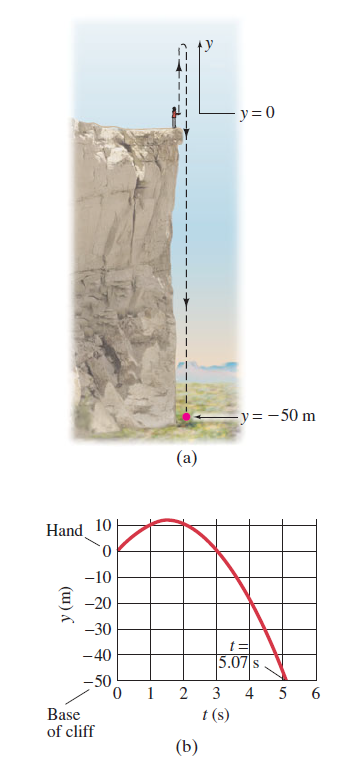
Falling from a Tower: Distance Fallen at Different Times
Falling from a tower
Suppose that a ball is dropped (v0 = 0) from a tower. How far will it have fallen after a time t1 = 1.00 s, t2 = 2.00 s, and t3 = 3.00 s? Ignore air resistance.
Given data
- Initial velocity: u = 0 m/s
- Acceleration due to gravity: g = 9.80 m/s2
- First time: t1 = 1.00 s
- Second time: t2 = 2.00 s
- Third time: t3 = 3.00 s
Step 1: Identify the type of motion
The ball is released from rest and falls freely under gravity. Air resistance is neglected, so the ball has constant downward acceleration.
Taking downward as the positive direction, we use the equation of motion:
s = ut + ½at2
Here, u = 0 and a = g.
s = ½gt2
Step 2: Distance fallen after 1.00 s
Substitute t = 1.00 s:
s1 = ½ × 9.80 × (1.00)2
s1 = 4.90 m
Distance fallen = 4.90 m
Step 3: Distance fallen after 2.00 s
Substitute t = 2.00 s:
s2 = ½ × 9.80 × (2.00)2
s2 = 4.90 × 4
s2 = 19.6 m
Distance fallen = 19.6 m
Step 4: Distance fallen after 3.00 s
Substitute t = 3.00 s:
s3 = ½ × 9.80 × (3.00)2
s3 = 4.90 × 9
s3 = 44.1 m
Distance fallen = 44.1 m
Final answers
| Time | Distance fallen |
|---|---|
| 1.00 s | 4.90 m |
| 2.00 s | 19.6 m |
| 3.00 s | 44.1 m |
Key idea
For an object dropped from rest under constant gravitational acceleration, the distance fallen is proportional to the square of elapsed time:
s ∝ t2
Therefore, doubling the time makes the distance four times greater, while tripling the time makes the distance nine times greater.