S ssvcollege.com
←

Freely Falling Objects - Problems - 2

1

Time Taken by a Dropped Package to Reach the Ground from an Ascending Helicopter

Question:

(II) A helicopter is ascending vertically with a speed of 5.40 m/s. At a height of 105 m above the Earth, a package is dropped from the helicopter. How much time does it take for the package to reach the ground?

Hint: What is the initial velocity of the package?

Given

  • Initial height: h = 105 m
  • Upward velocity of the helicopter: 5.40 m/s
  • Initial velocity of the package: u = +5.40 m/s
  • Acceleration due to gravity: a = −9.80 m/s²
  • Final position at the ground: y = 0 m

Understanding the Initial Velocity

The most important concept in this problem is that the package does not start from rest when it is released.

Just before release, the package is moving upward along with the helicopter at 5.40 m/s. At the instant it is dropped, it retains the same upward velocity.

Important Concept

Dropping an object means releasing it, not necessarily giving it zero initial velocity. The object retains the velocity it had immediately before release.

u = +5.40 m/s

Upward is taken as the positive direction.

Method 1: Using the Second Equation of Motion

We know the initial velocity, acceleration, and displacement. Therefore, we can use the second equation of motion to calculate the time directly.

s = ut + ½at²

Taking the release point as the reference for displacement, the ground is 105 m below the package.

s = −105 m

Substituting the values:

−105 = 5.40t + ½(−9.80)t²

Simplifying:

−105 = 5.40t − 4.90t²

Rearranging:

4.90t² − 5.40t − 105 = 0

Solving the Quadratic Equation

The equation is in the standard form At² + Bt + C = 0, where A = 4.90, B = −5.40, and C = −105.

Using the quadratic formula:

t = [−B ± √(B² − 4AC)]/(2A)

Substituting:

t = [5.40 ± √((-5.40)² − 4(4.90)(−105))]/9.80

Simplifying the expression under the square root:

t = [5.40 ± √(29.16 + 2058)]/9.80

t = [5.40 ± √2087.16]/9.80

Since √2087.16 ≈ 45.69:

t = (5.40 ± 45.69)/9.80

Taking the positive root:

t = (5.40 + 45.69)/9.80

t ≈ 5.21 s

The negative root gives a negative time, which corresponds mathematically to a time before the package was released. It is not relevant to the physical situation described.

Answer

The time taken for the package to reach the ground is approximately

t ≈ 5.21 s

Method 2: Using the First Equation of Motion

We can verify the answer by first calculating the velocity of the package just before it reaches the ground.

Using the third equation of motion:

v² = u² + 2as

v² = (5.40)² + 2(−9.80)(−105)

v² = 29.16 + 2058

v² = 2087.16

v = −45.69 m/s

The negative root is chosen because the package is moving downward when it reaches the ground.

Now use the first equation of motion:

v = u + at

−45.69 = 5.40 − 9.80t

9.80t = 5.40 + 45.69

t = 51.09/9.80

t ≈ 5.21 s

Both methods give the same result. The second equation calculates the time directly, while the alternative method calculates the impact velocity first and then uses the first equation of motion.

Motion of the Package After Release

After release, the package continues moving upward briefly because its initial velocity is upward. Gravity slows it down until it reaches its highest point, where its velocity becomes zero. It then falls toward the ground.

Package Motion Diagram

Ground Release height = 105 m Released Highest point Initial velocity 5.40 m/s upward Falls Ground impact

The package retains the helicopter’s upward velocity at release. Gravity then controls its motion.

Final Results

  • Initial velocity of the package: +5.40 m/s.
  • Acceleration after release: −9.80 m/s².
  • Time to reach the ground: 5.21 s.
  • Impact velocity: −45.69 m/s, approximately.
Key Idea: When an object is released from a moving vehicle, it retains the vehicle’s instantaneous velocity at the moment of release. It does not automatically start from rest.
2

Velocity of Falling Water Balloons and Determining the Release Floor

Question:

(II) Roger sees water balloons fall past his window. He notices that each balloon strikes the sidewalk 0.83 s after passing his window. Roger’s room is on the third floor, 15 m above the sidewalk.

(a) How fast are the balloons traveling when they pass Roger’s window?

(b) Assuming the balloons are being released from rest, from what floor are they being released? Each floor of the dorm is 5.0 m high.

Given

  • Height of Roger’s window above the sidewalk: h = 15 m
  • Time taken from the window to the sidewalk: t = 0.83 s
  • Acceleration due to gravity: g = 9.8 m/s²
  • Height of each floor: 5.0 m
  • Acceleration is downward and air resistance is neglected.

Understanding the Motion

The balloons are already moving downward when they pass Roger’s window. Therefore, their velocity at the window is not zero.

We will first calculate their velocity at the window using the 15 m distance and the 0.83 s falling time. Then we will determine how far above the window they were released.

Upper floors Floor Floor Floor 3rd floor Lower level Window 15 m high 0.83 s Sidewalk

The balloons pass the window with an unknown downward velocity and continue falling to the sidewalk.

(a) Speed of the Balloons at Roger’s Window

We know the displacement from the window to the sidewalk, the time taken, and the acceleration due to gravity. Therefore, we can use the second equation of motion to calculate the initial velocity for this part of the motion.

Step 1: Choose a Direction

Take downward as the positive direction for convenience. The balloons move downward from the window to the sidewalk.

  • Displacement: s = +15 m
  • Time: t = 0.83 s
  • Acceleration: a = +9.8 m/s²
  • Initial velocity at the window: u = ?

Step 2: Apply the Second Equation of Motion

s = ut + ½at²

Substitute the known values:

15 = u(0.83) + ½(9.8)(0.83)²

Calculate the gravitational term:

½(9.8)(0.6889) = 3.3756

Therefore:

15 = 0.83u + 3.3756

Rearranging:

0.83u = 15 − 3.3756

0.83u = 11.6244

Divide both sides by 0.83:

u = 11.6244/0.83

u ≈ 14.0 m/s

The calculated velocity is positive because downward was chosen as the positive direction. Thus, the balloons are traveling downward at approximately 14.0 m/s as they pass Roger’s window.

Answer for (a)

Speed = 14.0 m/s

Direction: Downward

(b) From Which Floor Are the Balloons Released?

The problem states that the balloons are released from rest. We can use this information to calculate the distance they fall before reaching Roger’s window.

Step 1: Find the Distance Fallen Before the Window

The balloons start from rest, so their initial velocity at the release point is zero. Using the third equation of motion between the release point and Roger’s window:

v² = u² + 2as

Here:

u = 0, v ≈ 14.0 m/s, a = 9.8 m/s²

v² = 0² + 2(9.8)s

Rearranging:

s = v²/(2g)

Using the unrounded velocity from part (a):

s ≈ (14.005)²/19.6

s ≈ 10.0 m

Therefore, the balloons were released approximately 10.0 m above Roger’s window.

Step 2: Calculate the Release Height Above the Sidewalk

Roger’s window is 15 m above the sidewalk. The release point is approximately 10.0 m above the window.

H = 15 + 10.0

H ≈ 25.0 m

Thus, the release point is approximately 25.0 m above the sidewalk.

Step 3: Determine the Floor Number

Each floor of the dorm is 5.0 m high. Divide the release height by the height of one floor:

Number of floor-heights = 25.0/5.0

= 5

The release point is therefore at a height corresponding to five floor-heights above the sidewalk.

Answer for (b)

The balloons are released from approximately the fifth-floor level, using the convention that each floor corresponds to 5.0 m of height.

Verification Using the First Equation of Motion

We can verify the speed at Roger’s window using the first equation of motion over the 0.83 s interval.

v = u + at

v = 14.005 + 9.8(0.83)

v ≈ 14.005 + 8.134

v ≈ 22.1 m/s

This is the velocity just before the balloons reach the sidewalk, not the velocity at Roger’s window.

Summary of Answers

Part Quantity Answer
(a) Speed at Roger’s window 14.0 m/s downward
(b) Release height 25.0 m above sidewalk
(b) Release floor level 5th-floor level

Key Equations

  • Second equation of motion: s = ut + ½at²
  • Third equation of motion: v² = u² + 2as
  • First equation of motion: v = u + at

Key Idea

When an object is released from rest, its initial velocity is zero at the release point. However, by the time it reaches a lower point, gravity has increased its speed. Use the velocity at the correct point for each stage of the calculation.

3

Initial Speed of Water Leaving a Vertically Pointed Garden Hose Nozzle

Initial Speed of Water Leaving a Vertically Pointed Garden Hose Nozzle

Question:

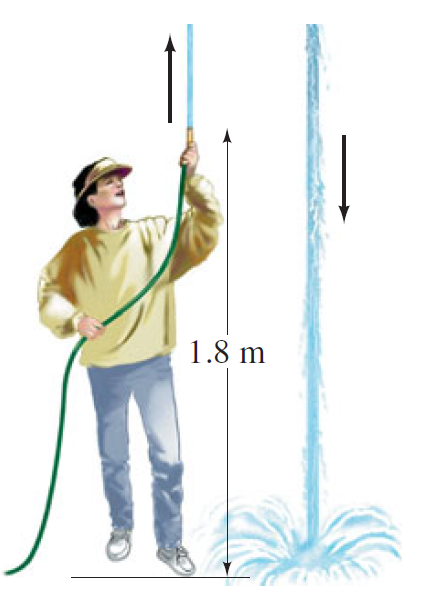
(II) Suppose you adjust your garden hose nozzle for a fast stream of water. You point the nozzle vertically upward at a height of 1.8 m above the ground (Fig. 2–40). When you quickly turn off the nozzle, you hear the water striking the ground next to you for another 2.5 s. What is the water speed as it leaves the nozzle?

Given

  • Height of the nozzle above the ground: h = 1.8 m
  • Time between turning off the nozzle and hearing the last water strike the ground: T = 2.5 s
  • Acceleration due to gravity: g = 9.8 m/s²
  • Initial water velocity: u = ?

Understanding the Problem

When the nozzle is turned off, the water already in the upward stream continues moving. The highest water droplets eventually stop rising, fall back down, and strike the ground.

The last water to hit the ground is the water that was highest in the stream when the nozzle was turned off. Therefore, the 2.5 s interval represents the time taken by that water to travel from its position in the stream to the ground.

We first determine the maximum height of the water above the ground. Then we use that height to calculate the initial speed at the nozzle.

Motion of the Last Water Droplet

Ground Nozzle u upward Highest droplet Falls Total height 1.8 m

The last droplet falls from the highest point reached by the water stream. The diagram is schematic.

Step 1: Calculate the Maximum Height of the Water

Consider the last droplet as it falls from the highest point of the stream to the ground.

At the highest point, its vertical velocity is zero. We take downward as the positive direction for this falling stage.

  • Initial velocity at the highest point: u = 0 m/s
  • Time of falling: t = 2.5 s
  • Acceleration: a = +9.8 m/s²

Using the Second Equation of Motion

s = ut + ½at²

Substituting the values:

s = 0(2.5) + ½(9.8)(2.5)²

s = 4.9 × 6.25

s = 30.625 m

Therefore, the highest point of the water stream is 30.625 m above the ground.

Step 2: Calculate the Rise Above the Nozzle

The nozzle is already 1.8 m above the ground. Therefore, the water rises a distance equal to the total maximum height minus the nozzle height.

h = 30.625 − 1.8

h = 28.825 m

This is the maximum vertical displacement of the water above the nozzle when it leaves the hose.

Step 3: Calculate the Initial Water Speed

Now consider the upward motion of the water from the nozzle to its highest point. At the nozzle, the water has an unknown initial upward speed. At the highest point, its velocity becomes zero.

Take upward as the positive direction for this stage.

  • Initial velocity: u = ?
  • Final velocity at the highest point: v = 0 m/s
  • Acceleration: a = −9.8 m/s²
  • Displacement: s = +28.825 m

Using the Third Equation of Motion

v² = u² + 2as

Substitute the known values:

0² = u² + 2(−9.8)(28.825)

Simplifying:

0 = u² − 19.6(28.825)

Rearranging:

u² = 19.6 × 28.825

u² = 564.97

u = √564.97

u ≈ 23.8 m/s

We choose the positive square root because the water leaves the nozzle moving vertically upward.

Final Answer

The speed of the water as it leaves the nozzle is approximately:

23.8 m/s

Direction: Vertically upward

Alternative Method: Using the Total Flight Time

We can also solve the problem by measuring displacement directly from the nozzle to the ground. This provides an independent check of the result.

Take upward as positive and choose the nozzle as the origin. The ground is at a displacement of −1.8 m. The last droplet reaches the ground 2.5 s after the nozzle is turned off.

s = ut + ½at²

−1.8 = u(2.5) + ½(−9.8)(2.5)²

−1.8 = 2.5u − 30.625

2.5u = 30.625 − 1.8

2.5u = 28.825

u = 28.825/2.5

u = 11.53 m/s

This alternative calculation uses 2.5 s as the flight time of a droplet starting at the nozzle. However, the 2.5 s interval in the question starts when the nozzle is turned off, and the last droplet is already above the nozzle at that moment. Therefore, this calculation does not represent the same physical motion as the first method.

The correct interpretation is that the last droplet is at the top of the stream when the nozzle is turned off. It then falls for 2.5 s. The first method therefore gives the intended initial speed.

Summary of the Solution

Step Quantity Result
1 Fall distance in 2.5 s 30.625 m
2 Rise above nozzle 28.825 m
3 Initial water speed 23.8 m/s

Key Equations

  • Second equation of motion: s = ut + ½at²
  • Third equation of motion: v² = u² + 2as
  • At the highest point: v = 0 m/s
  • Maximum height above the ground: H = nozzle height + rise above nozzle

Key Idea

When the water supply is turned off, the highest water droplet continues its motion and then falls to the ground. The time until the final splash can be used to find the maximum height, which in turn determines the initial speed of the water.

4

Initial Speed, Maximum Height, and Time of Flight of a Baseball

Question:

(III) A baseball is seen to pass upward by a window with a vertical speed of 14 m/s. If the ball was thrown by a person 18 m below on the street:

  • (a) What was its initial speed?
  • (b) What altitude does it reach?
  • (c) When was it thrown?
  • (d) When does it reach the street again?

Given

  • Height of the window above the street: h = 18 m
  • Upward velocity at the window: v = +14 m/s
  • Acceleration due to gravity: a = −9.8 m/s²
  • Initial velocity at the street: u = ?
  • Initial position: y₀ = 0 m

Understanding the Problem

The baseball is thrown vertically upward from the street. As it rises, gravity continuously reduces its upward speed. When it passes the window, its upward speed is 14 m/s. It continues rising until its velocity becomes zero at the highest point, after which it falls back toward the street.

We can solve all four parts using the equations of motion because the acceleration due to gravity is constant, assuming air resistance is negligible.

Motion of the Baseball

Street (y = 0) Throwing point Window v = +14 m/s 18 m above street Highest point v = 0 m/s Upward Downward 18 m

The ball passes the window while rising, reaches zero velocity at its maximum height, and then returns to the street.

(a) Find the Initial Speed of the Baseball

We know the velocity at the window and the vertical displacement from the street to the window. The time taken to reach the window is not yet known.

Therefore, use the third equation of motion, which relates velocity, acceleration, and displacement without requiring time.

Step 1: Choose the Positive Direction

Take upward as positive and set the street as the origin.

  • Initial velocity: u = ?
  • Velocity at the window: v = +14 m/s
  • Acceleration: a = −9.8 m/s²
  • Displacement to the window: s = +18 m

Step 2: Apply the Third Equation of Motion

v² = u² + 2as

Substitute the values:

14² = u² + 2(−9.8)(18)

Simplifying:

196 = u² − 352.8

Rearrange to find u²:

u² = 196 + 352.8

u² = 548.8

Taking the square root:

u = √548.8

u ≈ 23.43 m/s

The ball was thrown upward, so we take the positive root. Its initial speed is approximately 23.43 m/s.

Answer for (a)

Initial speed = 23.43 m/s

(b) Find the Maximum Altitude Reached

At the highest point, the baseball momentarily stops moving upward. Its vertical velocity is therefore zero.

We know the initial speed from part (a). We can use the third equation of motion again to calculate the maximum height above the street.

Step 1: Identify the Known Quantities

  • Initial velocity: u = 23.43 m/s
  • Final velocity at the highest point: v = 0 m/s
  • Acceleration: a = −9.8 m/s²
  • Maximum height above the street: H = ?

Step 2: Apply the Third Equation of Motion

v² = u² + 2aH

Substitute the values:

0² = 548.8 + 2(−9.8)H

Simplifying:

0 = 548.8 − 19.6H

Rearrange:

19.6H = 548.8

Divide both sides by 19.6:

H = 548.8/19.6

H = 28.0 m

The maximum altitude is 28.0 m above the street. Since the window is 18 m above the street, the ball rises a further 10.0 m after passing the window.

Height above the window

Δh = 28.0 − 18

Δh = 10.0 m

Answer for (b)

Maximum altitude = 28.0 m

Measured above the street

(c) How Long After the Throw Does the Ball Pass the Window?

The question asks when the ball was thrown, meaning the time interval between the throw and the ball passing the window.

We know the initial velocity, the velocity at the window, and the acceleration. Therefore, use the first equation of motion.

Step 1: Apply the First Equation of Motion

v = u + at

Substitute the values:

14 = 23.426 − 9.8t

Rearranging:

9.8t = 23.426 − 14

9.8t = 9.426

Divide by 9.8:

t = 9.426/9.8

t ≈ 0.962 s

Therefore, the ball passes the window approximately 0.962 seconds after it is thrown.

Answer for (c)

Time to reach the window ≈ 0.962 s

(d) When Does the Baseball Reach the Street Again?

The ball is thrown upward from the street and eventually returns to the same vertical position. Under constant gravitational acceleration and neglecting air resistance, the time of ascent equals the time of descent.

We have already calculated the time taken to rise to the highest point. We can find the total flight time by doubling this time.

Method 1: Using Symmetry of Vertical Motion

At the highest point, the velocity is zero. Using the first equation of motion:

v = u + at

0 = 23.426 − 9.8tup

9.8tup = 23.426

tup = 23.426/9.8

tup ≈ 2.390 s

Since the ball returns to its original height, the total time in the air is:

T = 2tup

T = 2(2.390)

T ≈ 4.78 s

Thus, the baseball reaches the street again approximately 4.78 seconds after it was thrown.

Method 2: Using the Second Equation of Motion

We can also calculate the total flight time directly. Taking the street as the origin, the final displacement when the ball returns to the street is zero.

s = ut + ½at²

0 = 23.426T + ½(−9.8)T²

0 = 23.426T − 4.9T²

T(23.426 − 4.9T) = 0

The solutions are:

T = 0

or 23.426 − 4.9T = 0

4.9T = 23.426

T ≈ 4.78 s

The solution T = 0 represents the instant the ball is initially thrown. The other solution represents the time when it returns to the street.

Answer for (d)

Total time in the air ≈ 4.78 s

Complete Timeline of the Baseball

1

Throw from the street

Time = 0 s; initial speed ≈ 23.43 m/s upward.

2

Pass the window while rising

Time ≈ 0.962 s; height = 18 m; speed = 14 m/s upward.

3

Reach the highest point

Time ≈ 2.390 s; maximum altitude = 28.0 m; velocity = 0.

4

Return to the street

Time ≈ 4.78 s after the throw.

Summary of Answers

Part Quantity Answer
(a) Initial speed 23.43 m/s
(b) Maximum altitude above street 28.0 m
(c) Time to reach window 0.962 s
(d) Total time to return to street 4.78 s

Important Equations

  • First equation of motion: v = u + at
  • Second equation of motion: s = ut + ½at²
  • Third equation of motion: v² = u² + 2as
  • At maximum height: v = 0 m/s
  • For a return to the same height: total flight time = 2 × time to maximum height.

Key Idea

The velocity of the baseball at the window is not its initial velocity. Gravity has already reduced its speed during the upward journey. By using the velocity at the window and its height above the street, we can determine the initial speed and then calculate the complete motion.

5

Height from Which a Stone Falls Above the Top of a Window

Height from Which a Stone Falls Above the Top of a Window

Question:

(III) A falling stone takes 0.31 s to travel past a window 2.2 m tall (Fig. 2–41). From what height above the top of the window did the stone fall?

Given

  • Height of the window: s = 2.2 m
  • Time taken to pass the window: t = 0.31 s
  • Initial velocity at the release point: u = 0 m/s
  • Acceleration due to gravity: g = 9.8 m/s²
  • Height above the top of the window: H = ?

Understanding the Problem

The stone is released from rest at some unknown height above the window. As it falls, gravity increases its downward speed. By the time it reaches the top of the window, it already has a nonzero velocity.

The stone takes 0.31 s to travel the 2.2 m height of the window. Therefore, we must first determine its speed at the top of the window. We can then calculate how far it fell before reaching the window.

Motion of the Falling Stone

Window Window Window Bottom of window Release point Unknown height H A vA B vB 2.2 m

Point A is the top of the window, and point B is the bottom. The stone accelerates downward as it passes from A to B.

Step 1: Calculate the Velocity at the Top of the Window

First, consider the motion while the stone passes the window. Take downward as the positive direction.

  • Displacement: s = +2.2 m
  • Time: t = 0.31 s
  • Acceleration: a = +9.8 m/s²
  • Initial velocity at the top of the window: u = ?

Use the Second Equation of Motion

s = ut + ½at²

Substitute the known values:

2.2 = u(0.31) + ½(9.8)(0.31)²

Calculate the gravitational term:

½(9.8)(0.0961) = 0.47089

Therefore:

2.2 = 0.31u + 0.47089

Rearranging:

0.31u = 2.2 − 0.47089

0.31u = 1.72911

Divide both sides by 0.31:

u = 1.72911/0.31

u ≈ 5.58 m/s

The stone is therefore moving downward at approximately 5.58 m/s when it reaches the top of the window.

Step 2: Find the Height Above the Window

The stone was released from rest. We now consider the motion from the release point to the top of the window. Its initial velocity at the release point is zero, and its velocity at the window is approximately 5.58 m/s.

  • Initial velocity: u = 0 m/s
  • Final velocity at the top of the window: v ≈ 5.58 m/s
  • Acceleration: a = +9.8 m/s²
  • Distance fallen before reaching the window: H = ?

Use the Third Equation of Motion

v² = u² + 2as

Substitute the values:

(5.5778)² = 0² + 2(9.8)H

Simplifying:

31.11 = 19.6H

Rearranging:

H = 31.11/19.6

H ≈ 1.59 m

Thus, the stone was released approximately 1.59 m above the top of the window.

Final Answer

H ≈ 1.6 m

Above the top of the window

Alternative Method: Using the Average Velocity

Since the stone falls with constant acceleration, its average velocity while passing the window is the arithmetic mean of its velocities at the top and bottom of the window.

s = [(u + v)/2]t

Rearranging:

u + v = 2s/t

u + v = 2(2.2)/0.31

u + v ≈ 14.19 m/s

This equation gives the sum of the velocities at the top and bottom of the window, not the velocity at the top by itself.

To find the velocity at the top, use the first equation of motion over the window:

v = u + at

Combining this with the average-velocity equation:

u = s/t − ½gt

u = 2.2/0.31 − ½(9.8)(0.31)

u ≈ 5.58 m/s

Then, using v² = u² + 2as for the fall from rest:

H = u²/(2g)

H ≈ 1.59 m

Summary of the Solution

Step Quantity Result
1 Time to pass the window 0.31 s
2 Window height 2.2 m
3 Speed at top of window 5.58 m/s downward
4 Height above window 1.59 m

Important Equations

  • Second equation of motion: s = ut + ½at²
  • Third equation of motion: v² = u² + 2as
  • Average velocity for constant acceleration: vavg = (u + v)/2
  • For a stone released from rest: H = v²/(2g)

Key Idea

A falling stone does not start from rest when it reaches the top of a window. It has already accelerated during the fall above the window. Calculate its velocity at the top first, then use that velocity to determine the release height.

6

Height of a Sea Cliff Using the Time Taken by a Falling Rock and Sound Travel

Question:

(III) A rock is dropped from a sea cliff, and the sound of it striking the ocean is heard 3.4 s later. If the speed of sound is 340 m/s, how high is the cliff?

Given

  • Total time from dropping the rock to hearing the sound: T = 3.4 s
  • Initial velocity of the rock: u = 0 m/s
  • Acceleration due to gravity: g = 9.8 m/s²
  • Speed of sound in air: vs = 340 m/s
  • Height of the cliff: H = ?

Understanding the Problem

The total time of 3.4 s includes two separate time intervals:

  • Time 1: The time taken by the rock to fall from the top of the cliff to the ocean.
  • Time 2: The time taken by the sound of the impact to travel from the ocean back to the top of the cliff.

The rock and the sound travel at different speeds. Therefore, we must calculate both time intervals and add them to obtain the total time of 3.4 s.

Motion of the Rock and Sound

Top of cliff Rock falls t₁ Ocean Sound travels upward t₂ H Total time: t₁ + t₂ = 3.4 s

The rock travels downward first. After impact, the sound travels upward to the observer.

Step 1: Express the Time Taken by the Rock to Fall

The rock is dropped from rest, so its initial velocity is zero. Let t₁ be the time taken by the rock to reach the ocean.

Apply the Second Equation of Motion

H = ut₁ + ½gt₁²

Since u = 0:

H = ½gt₁²

H = 4.9t₁²

Equation (1)

Step 2: Express the Time Taken by Sound to Travel Upward

Let t₂ be the time taken by the sound to travel from the ocean to the top of the cliff.

Using the relationship between distance, speed, and time:

Speed = Distance/Time

Therefore:

vs = H/t₂

Rearranging:

t₂ = H/340

Equation (2)

Step 3: Use the Total Time

The total time is the sum of the rock’s falling time and the sound’s travel time.

t₁ + t₂ = 3.4

Substitute t₂ = H/340:

t₁ + H/340 = 3.4

From Equation (1), H = 4.9t₁²:

t₁ + (4.9t₁²)/340 = 3.4

Multiply both sides by 340:

340t₁ + 4.9t₁² = 1156

Rearrange:

4.9t₁² + 340t₁ − 1156 = 0

Step 4: Solve the Quadratic Equation

We have obtained a quadratic equation in t₁:

4.9t₁² + 340t₁ − 1156 = 0

Using the quadratic formula:

t₁ = [−b ± √(b² − 4ac)]/(2a)

Here:

a = 4.9, b = 340, c = −1156

Substitute:

t₁ = [−340 ± √(340² + 4(4.9)(1156))]/9.8

Simplifying:

t₁ = [−340 ± √137254.4]/9.8

t₁ = [−340 ± 370.48]/9.8

Taking the positive time:

t₁ ≈ 3.11 s

The negative root is rejected because a negative falling time is not physically meaningful for this situation.

Step 5: Calculate the Height of the Cliff

Now use the distance equation for the falling rock:

H = ½gt₁²

Substitute t₁ ≈ 3.11 s:

H = 4.9(3.11)²

Therefore:

H ≈ 47.4 m

The cliff is approximately 47.4 m high. The result is less than the height obtained by assuming the rock falls for the entire 3.4 s, because some of that time is taken by the sound travelling upward.

Final Answer

Height of the cliff ≈ 47.4 m

Summary of Time Intervals

Quantity Value
Rock falling time ≈ 3.11 s
Sound travel time ≈ 0.14 s
Total time 3.4 s
Cliff height ≈ 47.4 m

Important Physics Concept

The total elapsed time is not equal to the falling time alone. It includes the time for the sound to travel back to the observer. Whenever a problem involves both a falling object and the sound of its impact, account for both time intervals.

←