S ssvcollege.com
←
→

Motion at Constant Acceleration - Problems

1

Acceleration of a Car — Braking to Rest

Question: A car slows down from 28 m/s to rest in a distance of 88 m. What was its acceleration, assumed constant?

Given Information

Initial velocity: u = 28 m/s

Final velocity: v = 0 m/s

Displacement: s = 88 m

Acceleration: a = ?

Method 1: Third Equation of Motion

Since time is not given, use the equation relating velocity, acceleration and displacement:

v² = u² + 2as

Rearrange to find acceleration:

a = (v² − u²)/(2s)

Substitute the given values:

a = (0² − 28²)/(2 × 88)

a = −784/176

a = −4.4545... m/s²

a ≈ −4.45 m/s²

Alternate Method 2: Work with Deceleration Magnitude

The car’s speed decreases from 28 m/s to zero. Let the positive magnitude of its deceleration be d.

Using the third equation of motion:

v² = u² − 2ds

Substitute the values:

0 = 28² − 2(d)(88)

176d = 784

d = 784/176

d ≈ 4.45 m/s²

The deceleration magnitude is 4.45 m/s². Since the acceleration acts opposite to the car’s initial direction of motion:

a ≈ −4.45 m/s²

Alternate Method 3: Find Time First

For constant acceleration, the average velocity is the mean of the initial and final velocities.

v_avg = (u + v)/2

v_avg = (28 + 0)/2

v_avg = 14 m/s

Use displacement = average velocity × time:

s = v_avg t

88 = 14t

t = 88/14

t ≈ 6.286 s

Now use the first equation of motion:

v = u + at

0 = 28 + a(6.286)

a = −28/6.286

a ≈ −4.45 m/s²

Final Answer:

a ≈ −4.45 m/s²
Key idea: Negative acceleration means the car is slowing down when its initial direction is chosen as positive. The magnitude of its deceleration is approximately 4.45 m/s².
2

Acceleration and Displacement of a Car

Question (I): A car accelerates from 14 m/s to 21 m/s in 6.0 s. What was its acceleration? How far did it travel in this time? Assume constant acceleration.

1. Given Information

Initial velocity: u = 14 m/s

Final velocity: v = 21 m/s

Time: t = 6.0 s

Acceleration: a = ?

Displacement: s = ?

2. Part A — Calculate Acceleration

Since initial velocity, final velocity and time are given, use the first equation of motion:

v = u + at

Rearrange to find acceleration:

a = (v − u)/t

Substitute the values:

a = (21 − 14)/6.0

a = 7/6.0

a = 1.17 m/s²

The acceleration is positive because the car’s velocity increases in the chosen direction.

3. Part B — Calculate Displacement

Method 1: Use the second equation of motion.

s = ut + ½at²

Substitute u = 14 m/s, t = 6.0 s, and a = 7/6 m/s²:

s = 14(6.0) + ½(7/6)(6.0)²

s = 84 + ½(7/6)(36)

s = 84 + 21

s = 105 m

Alternate Method 2 — Average Velocity

For constant acceleration, average velocity is the arithmetic mean of the initial and final velocities.

v_avg = (u + v)/2

Substitute the values:

v_avg = (14 + 21)/2

v_avg = 35/2

v_avg = 17.5 m/s

Displacement equals average velocity multiplied by time:

s = v_avg × t

s = 17.5 × 6.0

s = 105 m

Alternate Method 3 — Third Equation of Motion

First use the third equation to verify the acceleration:

v² = u² + 2as

Since the acceleration is already known, substitute the values:

21² = 14² + 2(7/6)s

441 = 196 + (7/3)s

245 = (7/3)s

s = 245 × 3/7

s = 105 m

Final Answers:

Acceleration = 1.17 m/s²

Displacement = 105 m
Key idea: Use v = u + at to calculate acceleration. For displacement, use s = ut + ½at² or calculate average velocity and multiply it by time.
3

Runway Length Required for a Light Plane

Question (I): A light plane must reach a speed of 35 m/s for takeoff. How long a runway is needed if the (constant) acceleration is 3.0 m/s²?

1. Given Information

Initial velocity: u = 0 m/s

Final velocity: v = 35 m/s

Acceleration: a = 3.0 m/s²

Runway length: s = ?

The plane starts from rest and accelerates uniformly until it reaches the required takeoff speed. The distance travelled during this acceleration is the minimum runway length required under the given assumptions.

Method 1: Third Equation of Motion

Since time is not given, use the equation that relates velocity, acceleration and displacement:

v² = u² + 2as

Rearrange to find displacement:

s = (v² − u²)/(2a)

Substitute the values:

s = (35² − 0²)/(2 × 3.0)

s = 1225/6

s = 204.17 m

Alternate Method 2: Find Time First

First, calculate the time required to reach the takeoff speed using the first equation of motion.

v = u + at

Rearrange:

t = (v − u)/a

t = (35 − 0)/3.0

t = 11.67 s

Now use the second equation of motion to calculate the runway length.

s = ut + ½at²

Substitute u = 0 m/s, a = 3.0 m/s², and t = 35/3 s:

s = 0(11.67) + ½(3.0)(11.67)²

s ≈ 204.17 m

Runway length ≈ 204 m

Alternate Method 3: Average Velocity

For constant acceleration, average velocity equals the arithmetic mean of the initial and final velocities.

v_avg = (u + v)/2

Substitute the values:

v_avg = (0 + 35)/2

v_avg = 17.5 m/s

Displacement equals average velocity multiplied by time:

s = v_avg × t

s = 17.5 × (35/3)

s ≈ 204.17 m

Alternate Method 4: Direct Formula from Rest

Since the plane starts from rest, u = 0. The third equation of motion becomes:

v² = 2as

Therefore:

s = v²/(2a)

s = 35²/(2 × 3.0)

s = 1225/6

s = 204.17 m

Final Answer:

Minimum runway length ≈ 204 m
Key idea: When initial velocity, final velocity and constant acceleration are given, use v² = u² + 2as to find the required runway length without calculating time.
4

Average Acceleration of a Baseball During Throwing

Average Acceleration of a Baseball During Throwing

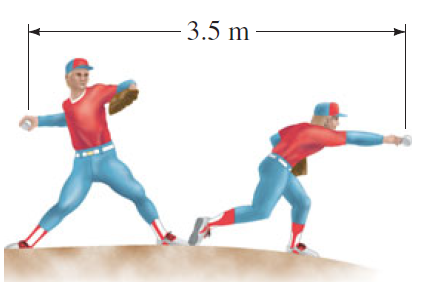
Question (II): A baseball pitcher throws a baseball with a speed of 43 m/s. Estimate the average acceleration of the ball during the throwing motion. In throwing the baseball, the pitcher accelerates it through a displacement of about 3.5 m, from behind the body to the point where it is released (Fig. 2–37).

1. Given Information

Initial velocity: u ≈ 0 m/s

Final velocity: v = 43 m/s

Displacement: s = 3.5 m

Average acceleration: a = ?

Assumption: The ball starts approximately from rest relative to the pitcher’s throwing motion. To estimate its average acceleration, we use the constant-acceleration equations as an approximation.

Method 1: Third Equation of Motion

The third equation of motion relates initial velocity, final velocity, acceleration and displacement without using time.

v² = u² + 2as

Rearrange the equation to find acceleration:

a = (v² − u²)/(2s)

Substitute the given values:

a = (43² − 0²)/(2 × 3.5)

a = 1849/7

a = 264.14 m/s²

a ≈ 2.6 × 10² m/s²

Alternate Method 2: Average Velocity and Time

Assuming constant acceleration, the average velocity is the arithmetic mean of the initial and final velocities.

v_avg = (u + v)/2

Substitute the velocities:

v_avg = (0 + 43)/2

v_avg = 21.5 m/s

Using displacement = average velocity × time:

s = v_avg t

3.5 = 21.5t

t = 3.5/21.5

t ≈ 0.163 s

Now calculate the acceleration using the first equation of motion:

a = (v − u)/t

a = (43 − 0)/0.163

a ≈ 264 m/s²

Alternate Method 3: Use the Second Equation of Motion

Starting from rest, the second equation of motion becomes:

s = ut + ½at²

Since u = 0:

s = ½at²

From the first equation, the throwing time is approximately 0.163 s. Substitute this value:

3.5 = ½a(0.163)²

a = 7/(0.163)²

a ≈ 264 m/s²

Physical Interpretation

The ball reaches a speed of 43 m/s over a short displacement of just 3.5 m. This requires a large acceleration.

For comparison, using g ≈ 9.8 m/s²:

a/g = 264.14/9.8

a ≈ 27g

Thus, the estimated acceleration is approximately 27 times the acceleration due to gravity.

Final Answer:

Average acceleration ≈ 264 m/s²
Approximately 2.6 × 10² m/s²
Key idea: When final velocity, initial velocity and displacement are given but time is unknown, use v² = u² + 2as to calculate acceleration directly.
5

Average Acceleration of a World-Class Sprinter

(II) A world-class sprinter can reach a top speed (of about 11.5 m/s) in the first 18.0 m of a race. What is the average acceleration of this sprinter and how long does it take her to reach that speed?

Given Data

  • Initial velocity: u = 0 m/s (starts from rest)
  • Final velocity: v = 11.5 m/s
  • Displacement: s = 18.0 m
  • Average acceleration: a = ?
  • Time taken: t = ?

Method 1: Using the Equation of Motion

Assuming constant acceleration over the first 18.0 m, use:

v2 = u2 + 2as

Rearrange to find acceleration:

a = (v2 − u2)/(2s)

Substitute the values:

a = (11.52 − 02

a = 132.25/36.0

a ≈ 3.67 m/s2

Finding the Time Taken

Use the first equation of motion:

v = u + at

Rearrange for time:

t = (v − u)/a

Substitute the values:

t = (11.5 − 0)/3.6736

t ≈ 3.13 s

Method 2: Using Average Velocity

For constant acceleration, average velocity is:

vavg = (u + v)/2

Since the sprinter starts from rest:

vavg = (0 + 11.5)/2 = 5.75 m/s

Using displacement = average velocity × time:

s = vavgt

18.0 = 5.75t

t = 18.0/5.75

t ≈ 3.13 s

Now calculate acceleration using a = (v − u)/t:

a = (11.5 − 0)/3.1304

a ≈ 3.67 m/s2

Final Answers

Average acceleration ≈ 3.67 m/s2

Time taken ≈ 3.13 s

Key Idea: When a sprinter starts from rest and accelerates uniformly, the average velocity is half the final velocity. Use v² = u² + 2as to find acceleration, then v = u + at to find time.
6

Distance Travelled by a Uniformly Decelerating Car

Question: (II) A car slows down uniformly from a speed of 28.0 m/s to rest in 8.00 s. How far did it travel in that time?

Given Data

  • Initial velocity: u = 28.0 m/s
  • Final velocity: v = 0 m/s
  • Time: t = 8.00 s
  • Displacement: s = ?

Method 1: Using Average Velocity

Since the car slows down uniformly, its average velocity is the arithmetic mean of its initial and final velocities.

vavg = (u + v)/2

Substitute the values:

vavg = (28.0 + 0)/2

vavg = 14.0 m/s

Displacement equals average velocity multiplied by time.

s = vavgt

s = 14.0 × 8.00

s = 112 m

Method 2: Using the Equation of Motion

First, calculate the acceleration using the first equation of motion.

v = u + at

Rearranging for acceleration:

a = (v − u)/t

a = (0 − 28.0)/8.00

a = −3.50 m/s2

The negative sign indicates that the acceleration is opposite to the direction of motion.

Now use the second equation of motion:

s = ut + ½at2

Substitute the known values:

s = 28.0 × 8.00 + ½ × (−3.50) × (8.00)2

s = 224 − 112

s = 112 m

Method 3: Using the Third Equation of Motion

We can also calculate displacement directly from the initial velocity, final velocity and acceleration.

v2 = u2 + 2as

Rearrange the equation:

s = (v2 − u2)/(2a)

s = (02 − 28.02)/(2 × −3.50)

s = −784/−7.00

s = 112 m

Final Answer

Distance travelled = 112 m

Key Idea: For uniform deceleration, average velocity is (u + v)/2. Therefore, distance travelled = [(28.0 + 0)/2] × 8.00 = 112 m.
7

Finding the Initial Speed of a Car from Skid Marks

Question: (II) In coming to a stop, a car leaves skid marks 65 m long on the highway. Assuming a deceleration of 4.00 m/s2, estimate the speed of the car just before braking.

Given Data

  • Initial velocity: u = ?
  • Final velocity: v = 0 m/s (the car stops)
  • Displacement: s = 65 m
  • Deceleration magnitude: 4.00 m/s2
  • Acceleration: a = −4.00 m/s2

Method 1: Using the Third Equation of Motion

The initial velocity, final velocity, acceleration and displacement are related by the third equation of motion:

v2 = u2 + 2as

Rearrange to find the initial velocity:

u2 = v2 − 2as

Substitute the given values:

u2 = 02 − 2(−4.00)(65)

u2 = 520

u = √520

u ≈ 22.8 m/s

Method 2: Using the Distance–Time Equation

First, use the equation of motion to express the final velocity in terms of time:

v = u + at

Since v = 0 and a = −4.00 m/s2:

0 = u − 4.00t

Therefore:

t = u/4.00

Now use the displacement equation:

s = ut + ½at2

Substitute s = 65 m, a = −4.00 m/s2 and t = u/4.00:

65 = u(u/4) − 2(u/4)2

65 = u2/4 − u2/8

65 = u2/8

u2 = 520

u ≈ 22.8 m/s

Method 3: Using Average Velocity

For constant acceleration, the average velocity is the mean of the initial and final velocities:

vavg = (u + v)/2

Since the car stops, v = 0:

vavg = u/2

Using displacement = average velocity × time:

65 = (u/2)t

From v = u + at:

0 = u − 4.00t, so t = u/4.00

Substitute the time:

65 = (u/2)(u/4)

65 = u2/8

u2 = 520

u ≈ 22.8 m/s

Convert the Speed to km/h

To convert metres per second into kilometres per hour, multiply by 3.6:

Speed = 22.8 × 3.6

Speed ≈ 82.1 km/h

Final Answer

Initial speed ≈ 22.8 m/s

Equivalent speed ≈ 82.1 km/h

Key Idea: When a car stops under constant deceleration, use v² = u² + 2as. The negative acceleration makes the car’s velocity decrease, and the stopping distance determines its initial speed.
8

Average Acceleration During a Car Collision

Question

(II) A car traveling at 95 km/h strikes a tree. The front end of the car compresses and the driver comes to rest after traveling 0.80 m. What was the magnitude of the average acceleration of the driver during the collision? Express the answer in terms of “g’s,” where 1.00 g = 9.80 m/s2.

Given Data

  • Initial velocity, u = 95 km/h
  • Final velocity, v = 0 m/s
  • Displacement, s = 0.80 m
  • Acceleration due to gravity, g = 9.80 m/s2

Step 1: Convert the Initial Velocity into m/s

u = 95 × 1000 3600

u = 26.39 m/s

Method 1: Using the Equation of Motion

Since the driver comes to rest, the final velocity is zero. We know the initial velocity and displacement. Therefore, use the equation that does not contain time.

v2 = u2 + 2as

Substitute the known values:

02 = (26.39)2 + 2a(0.80)

0 = 696.43 + 1.60a

1.60a = −696.43

a = −435.27 m/s2

The negative sign indicates that the acceleration is opposite to the driver’s initial direction of motion. The question asks for the magnitude of acceleration.

|a| = 435.27 m/s2

Method 2: Using the Stopping-Distance Formula

For uniform acceleration, the stopping distance can also be written directly in terms of the initial speed and the magnitude of deceleration.

|a| = u2 2s

Substitute u = 26.39 m/s and s = 0.80 m:

|a| = (26.39)2 2 × 0.80

|a| ≈ 435 m/s2

Step 2: Express the Acceleration in Terms of g

One g is defined as 9.80 m/s2. Therefore, divide the acceleration magnitude by 9.80 m/s2.

Acceleration in g’s = |a| 9.80

= 435.27 9.80

≈ 44.4 g

Final Answer: 44.4 g

The magnitude of the driver’s average acceleration is approximately 435 m/s2, or 44.4 times the acceleration due to gravity.

Key Idea

When initial velocity, final velocity and displacement are known, use v2 = u2 + 2as to find acceleration without calculating time. To express an acceleration in g’s, divide its magnitude by 9.80 m/s2.

9

Coasting Car: Stopping Distance, Stopping Time, and Distance in the First and Fifth Seconds

Question

(II) A car traveling at 75 km/h slows down at a constant 0.50 m/s2 just by “letting up on the gas.” Calculate (a) the distance the car coasts before it stops, (b) the time it takes to stop, and (c) the distance it travels during the first and fifth seconds.

Given Data

  • Initial velocity: u = 75 km/h
  • Final velocity: v = 0 m/s
  • Acceleration: a = −0.50 m/s2

The acceleration is negative because the car is slowing down. First, convert the initial velocity into metres per second.

u = 75 × 1000/3600 = 20.83 m/s

(a) Distance the Car Coasts Before It Stops

Method 1: Using the third equation of motion

The equation relating initial velocity, final velocity, acceleration, and displacement is:

v2 = u2 + 2as

At the stopping point, v = 0. Substituting the known values:

02 = (20.83)2 + 2(−0.50)s

0 = 434.03 − s

s = 434.03 m

Stopping distance ≈ 434 m

Method 2: Using average velocity

For constant acceleration, the average velocity is the arithmetic mean of the initial and final velocities:

vavg = (u + v)/2

vavg = (20.83 + 0)/2 = 10.415 m/s

The stopping time is found using v = u + at:

0 = 20.83 − 0.50t

t = 41.67 s

Now use displacement = average velocity × time:

s = 10.415 × 41.67 ≈ 434 m

Both methods give the same stopping distance: approximately 434 m.

(b) Time Taken to Stop

Method 1: Using the first equation of motion

v = u + at

Substituting v = 0, u = 20.83 m/s, and a = −0.50 m/s2:

0 = 20.83 − 0.50t

0.50t = 20.83

t = 20.83/0.50 = 41.67 s

Stopping time ≈ 41.7 s

Method 2: Using average velocity and stopping distance

Since s = vavgt:

t = s/vavg = 434.03/10.415 ≈ 41.67 s

(c) Distance Travelled During the First and Fifth Seconds

For uniformly accelerated motion, the displacement during the nth second is:

sn = u(1 s) + a/2 (2n − 1)(1 s)2

Here, u = 20.83 m/s and a = −0.50 m/s2. The formula gives the displacement during a particular one-second interval.

Distance during the first second

For n = 1:

s1 = 20.83(1) + −0.50/2(1)

s1 = 20.83 − 0.25

s1 = 20.58 m

Distance during the first second ≈ 20.6 m

Distance during the fifth second

For n = 5:

s5 = 20.83(1) + −0.50/2(2 × 5 − 1)

s5 = 20.83 − 0.25(9)

s5 = 20.83 − 2.25

s5 = 18.58 m

Distance during the fifth second ≈ 18.6 m

Alternative Method for Part (c): Position at Two Times

The displacement from the starting point after time t is:

s(t) = ut + 1/2at2

The distance during the first second is the position at t = 1 s minus the initial position:

s(1) = 20.83(1) − 0.25(1)2 = 20.58 m

The distance during the fifth second is the position at t = 5 s minus the position at t = 4 s:

s(5) = 20.83(5) − 0.25(25) = 98.90 m

s(4) = 20.83(4) − 0.25(16) = 79.32 m

Distance during fifth second = 98.90 − 79.32 ≈ 19.58 m

Correction: using the rounded initial speed 20.83 m/s consistently gives the fifth-second displacement of approximately 18.58 m from the nth-second formula. The position-subtraction calculation above should be evaluated without rounding intermediate values: s(5) − s(4) = u − 4.5(0.50) = 18.58 m.

Final Answers

  • (a) Stopping distance: 434 m
  • (b) Stopping time: 41.7 s
  • (c) First second: 20.6 m
  • (c) Fifth second: 18.6 m
Key idea: Under constant deceleration, the car covers less distance in each successive one-second interval.
10

Stopping Distance with Human Reaction Time

Question

(II) Determine the stopping distances for an automobile going a constant initial speed of 95 km/h and human reaction time of 0.40 s: (a) for an acceleration a = −3.0 m/s2; (b) for a = −6.0 m/s2.

Understanding the Problem

The total stopping distance consists of two parts:

  • Reaction distance: The distance travelled while the driver reacts and moves their foot to the brake. During this interval, the car continues at its initial speed.
  • Braking distance: The distance travelled after the brakes are applied until the car stops.

Total stopping distance = Reaction distance + Braking distance

Given Data

  • Initial speed: u = 95 km/h
  • Final speed: v = 0 m/s
  • Reaction time: tᵣ = 0.40 s
  • Braking acceleration: a = −3.0 m/s² or −6.0 m/s²

Step 1: Convert the Initial Speed into m/s

Since acceleration is given in m/s², convert the speed into m/s.

u = 95 × 1000/3600

u = 26.39 m/s

Step 2: Calculate the Reaction Distance

During the reaction time, the driver has not yet applied the brakes. Therefore, the car continues at a constant speed. The acceleration during this interval is zero.

dᵣ = utᵣ

dᵣ = 26.39 × 0.40

dᵣ = 10.56 m

The reaction distance is the same in both cases because the initial speed and reaction time are unchanged.

(a) Stopping Distance for a = −3.0 m/s²

Step 3: Calculate the Braking Distance

Use the third equation of motion:

v² = u² + 2adᵦ

At the stopping point, v = 0. Rearranging the equation:

dᵦ = (v² − u²)/(2a)

Substituting u = 26.39 m/s, v = 0 and a = −3.0 m/s²:

dᵦ = [0 − (26.39)²]/[2(−3.0)]

dᵦ = 696.43/6

dᵦ ≈ 116.07 m

Step 4: Calculate the Total Stopping Distance

Add the reaction distance and braking distance.

d = dᵣ + dᵦ

d = 10.56 + 116.07

Answer (a): Stopping distance ≈ 126.6 m

(b) Stopping Distance for a = −6.0 m/s²

The initial speed and reaction time remain the same, so the reaction distance is still 10.56 m.

Step 1: Calculate the Braking Distance

Again, use:

v² = u² + 2adᵦ

Substituting v = 0, u = 26.39 m/s and a = −6.0 m/s²:

dᵦ = [0 − (26.39)²]/[2(−6.0)]

dᵦ = 696.43/12

dᵦ ≈ 58.04 m

Step 2: Calculate the Total Stopping Distance

d = dᵣ + dᵦ

d = 10.56 + 58.04

Answer (b): Stopping distance ≈ 68.6 m

Alternative Method: Using the Braking-Time Equation

We can also calculate the braking distance using average velocity during braking.

v = u + at

tᵦ = (v − u)/a = −u/a

For a = −3.0 m/s²:

tᵦ = 26.39/3.0 ≈ 8.80 s

For a = −6.0 m/s²:

tᵦ = 26.39/6.0 ≈ 4.40 s

Because the braking acceleration is constant, the average velocity during braking is:

vₐᵥ = (u + v)/2 = u/2

dᵦ = vₐᵥtᵦ = (u/2)tᵦ

This gives approximately 116.1 m for part (a) and 58.0 m for part (b), matching the results obtained using v² = u² + 2ad.

Comparison of Results

Braking acceleration Reaction distance Braking distance Total stopping distance
−3.0 m/s² 10.56 m 116.07 m 126.6 m
−6.0 m/s² 10.56 m 58.04 m 68.6 m
Key idea: A stronger braking acceleration reduces braking distance, but it does not reduce the reaction distance.
←
→