S ssvcollege.com
←
→

Motion at Constant Acceleration - Problems - 2

1

Stopping at a Red Light: Reaction Distance and Braking Distance

Question

(II) A driver is traveling 18.0 m/s when she sees a red light ahead. Her car is capable of decelerating at a rate of 3.65 m/s2. If it takes her 0.350 s to get the brakes on and she is 20.0 m from the intersection when she sees the light, will she be able to stop in time? How far from the beginning of the intersection will she be, and in what direction?

Given Data

  • Initial velocity: u = 18.0 m/s
  • Final velocity for stopping: v = 0 m/s
  • Deceleration magnitude: 3.65 m/s²
  • Reaction time: tᵣ = 0.350 s
  • Distance to intersection: 20.0 m

Understanding the Motion

The car travels in two stages:

  • Reaction stage: The driver has seen the red light but has not yet applied the brakes. The car continues at 18.0 m/s.
  • Braking stage: The brakes are applied, and the car decelerates at 3.65 m/s² until it stops.

Total stopping distance = Reaction distance + Braking distance

Step 1: Calculate the Reaction Distance

During the reaction time, the velocity remains constant. Therefore, use:

dᵣ = utᵣ

dᵣ = 18.0 × 0.350

dᵣ = 6.30 m

The car travels 6.30 m before the brakes are applied. The remaining distance to the intersection is:

d remaining = 20.0 − 6.30

Remaining distance = 13.70 m

Step 2: Calculate the Braking Distance

Use the third equation of motion because the initial velocity, final velocity, and acceleration are known.

v² = u² + 2as

Take the direction of the car’s motion as positive. During braking, a = −3.65 m/s².

0² = (18.0)² + 2(−3.65)dᵦ

0 = 324 − 7.30dᵦ

7.30dᵦ = 324

dᵦ = 324/7.30

Braking distance ≈ 44.38 m

Step 3: Calculate the Total Stopping Distance

d total = dᵣ + dᵦ

d total = 6.30 + 44.38

Total stopping distance ≈ 50.68 m

Step 4: Will the Car Stop Before the Intersection?

The car is only 20.0 m from the intersection, but it needs approximately 50.68 m to stop.

50.68 m > 20.0 m

No. The car cannot stop before reaching the intersection.

Step 5: Find How Far the Car Travels Beyond the Intersection

Choose the position where the driver first sees the red light as x = 0. The beginning of the intersection is then at x = 20.0 m.

The car stops after travelling 50.68 m from its initial position. Therefore, its final position relative to the beginning of the intersection is:

x final relative to intersection = 50.68 − 20.0

x = 30.68 m beyond the beginning of the intersection

The positive result means the car stops beyond the beginning of the intersection, in the original direction of travel.

Alternative Method: Calculate the Velocity at the Intersection

The car has 13.70 m remaining when the brakes are applied. Use the third equation of motion to find its speed after braking over this distance:

v² = u² + 2as

v² = (18.0)² + 2(−3.65)(13.70)

v² = 324 − 100.01

v = √223.99

v ≈ 14.97 m/s

Since the velocity is still positive at the intersection, the car is still moving forward when it reaches it. It therefore cannot stop in time.

Final Answers

  • Reaction distance: 6.30 m
  • Braking distance: 44.38 m
  • Total stopping distance: 50.68 m
  • Can the car stop in time? No.
  • Stopping position: 30.7 m beyond the beginning of the intersection
  • Speed at the intersection: approximately 15.0 m/s forward
Key idea: Reaction distance must be included in stopping distance. Even strong braking cannot compensate for insufficient distance once the driver reacts too late.
2

Speed of the Last Car as the Train Passes a Worker

Speed of the Last Car as the Train Passes a Worker

Question

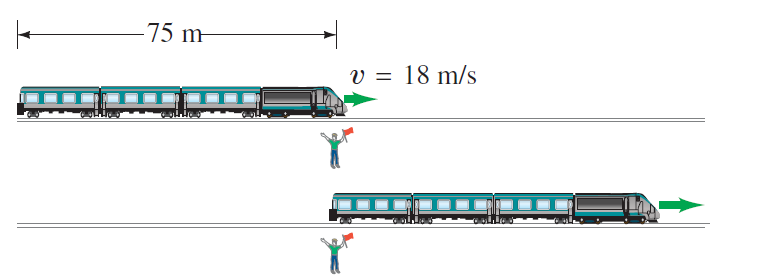
(II) A 75-m-long train begins uniform acceleration from rest. The front of the train has a speed of 18 m/s when it passes a railway worker who is standing 180 m from where the front of the train started. What will be the speed of the last car as it passes the worker? (See Fig. 2–38.)

Given

  • Length of train, L = 75 m
  • Initial velocity, u = 0 m/s
  • Distance travelled by the front to reach the worker, s = 180 m
  • Velocity of the front at that instant, v = 18 m/s
  • Acceleration is constant.

Step 1: Find the acceleration of the train

Since the train starts from rest and accelerates uniformly, use the third equation of motion:

v² = u² + 2as

Substitute the known values:

18² = 0² + 2a(180)

324 = 360a

a = 0.90 m/s²

Step 2: Find the distance travelled by the front when the last car reaches the worker

The worker is 180 m from the train’s starting point. For the last car to pass the worker, the front of the train must travel an additional distance equal to the train’s length, 75 m.

Distance travelled by the front:

s = 180 + 75 = 255 m

Step 3: Find the speed of the train at 255 m

Apply the third equation of motion again, using the same acceleration and initial velocity:

v² = u² + 2as

v² = 0² + 2(0.90)(255)

v² = 459

v = √459 = 21.4 m/s

Final Answer

21.4 m/s

Alternative Method: Find the time first

We can also solve the problem by finding the time taken for the front of the train to travel 180 m and then finding the speed after it travels another 75 m.

First, use the equation of motion:

v = u + at

18 = 0 + 0.90t

t₁ = 20 s

Now find the total time for the front to travel 255 m, starting from rest:

s = ut + ½at²

255 = 0 + ½(0.90)t²

255 = 0.45t²

t² = 566.67

t ≈ 23.8 s

Then calculate the velocity:

v = u + at

v = 0 + 0.90(23.8)

v ≈ 21.4 m/s

Key Idea

When the last car passes the worker, the front of the train has travelled the worker’s distance plus the train’s length. Because the train accelerates uniformly, the speed at that position can be found using v² = u² + 2as.

3

Distance Travelled by a Space Vehicle Between Two Instants

Question

(II) A space vehicle accelerates uniformly from 85 m/s at t = 0 to 162 m/s at t = 10.0 s. How far did it move between t = 2.0 s and t = 6.0 s?

Given

  • Initial velocity, u = 85 m/s
  • Velocity at t = 10.0 s, v = 162 m/s
  • Initial time, t₀ = 0 s
  • Required time interval: 2.0 s to 6.0 s
  • Acceleration is constant.

Method 1: Use the equations of motion

Step 1: Calculate the constant acceleration using the first equation of motion.

v = u + at

162 = 85 + a(10)

77 = 10a

a = 7.7 m/s²

Step 2: Calculate the displacement from t = 0 to t = 2.0 s.

Using the second equation of motion:

s = ut + ½at²

s₂ = 85(2) + ½(7.7)(2²)

s₂ = 170 + 15.4

s₂ = 185.4 m

Step 3: Calculate the displacement from t = 0 to t = 6.0 s.

s₆ = 85(6) + ½(7.7)(6²)

s₆ = 510 + 138.6

s₆ = 648.6 m

Step 4: Find the displacement between t = 2.0 s and t = 6.0 s by subtracting the two positions.

Distance travelled = s₆ − s₂

= 648.6 − 185.4

= 463.2 m

Method 2: Use average velocity over the time interval

For uniform acceleration, average velocity is the arithmetic mean of the initial and final velocities for the interval.

vₜ = u + at

Velocity at t = 2.0 s:

v₂ = 85 + 7.7(2) = 100.4 m/s

Velocity at t = 6.0 s:

v₆ = 85 + 7.7(6) = 131.2 m/s

Calculate the average velocity:

v_avg = (v₂ + v₆)/2

v_avg = (100.4 + 131.2)/2

v_avg = 115.8 m/s

The elapsed time is:

Δt = 6.0 − 2.0 = 4.0 s

Distance = v_avg × Δt

Distance = 115.8 × 4.0

Distance = 463.2 m

Final Answer

463.2 m

Key Idea

When acceleration is constant, the distance travelled between two times can be calculated by subtracting the displacements measured from the same starting point, or by multiplying the interval’s average velocity by the elapsed time.

4

Runner Accelerating to Meet a Target Time

Question

(II) A runner hopes to complete the 10,000-m run in less than 30.0 min. After running at constant speed for exactly 27.0 min there are still 1200 m to go. The runner must then accelerate at 0.20 m/s² for how many seconds in order to achieve the desired time?

Given

  • Total race distance = 10,000 m
  • Total target time = 30.0 min = 1800 s
  • Time already elapsed = 27.0 min = 1620 s
  • Remaining distance = 1200 m
  • Acceleration, a = 0.20 m/s²
  • Acceleration is assumed constant during the remaining motion.

Step 1: Calculate the remaining time

The runner wants to finish the race in 30.0 min and has already run for 27.0 min.

Remaining time = 30.0 − 27.0

Remaining time = 3.0 min

T = 3.0 × 60 = 180 s

Step 2: Find the runner’s initial speed

Before accelerating, the runner covers 10,000 − 1200 = 8800 m in 1620 s at constant speed.

Using the definition of constant speed:

u = Distance / Time

u = 8800 / 1620

u ≈ 5.432 m/s

Step 3: Use the equation of motion

Let t be the number of seconds the runner accelerates at 0.20 m/s². The runner covers 1200 m during the remaining 180 s, so the motion during this interval satisfies:

s = ut + ½at²

1200 = 5.432t + ½(0.20)t²

1200 = 5.432t + 0.10t²

0.10t² + 5.432t − 1200 = 0

Step 4: Solve the quadratic equation

Using the quadratic formula, t = [−b ± √(b² − 4ac)] / 2a:

t = [−5.432 ± √(5.432² + 4(0.10)(1200))] / 0.20

t = [−5.432 ± √509.51] / 0.20

t = [−5.432 ± 22.572] / 0.20

t ≈ 85.7 s

The negative root represents a negative time and is not physically meaningful, so we reject it.

Step 5: Check whether the target time is achieved

The runner accelerates for approximately 85.7 s and then runs at the resulting speed for the rest of the 180 s interval.

The remaining time at the new speed is:

180 − 85.7 = 94.3 s

Required acceleration time ≈ 85.7 s

Final Answer

85.7 s

Key Idea

When an object accelerates from an existing speed, its displacement is s = ut + ½at², not just ½at². The initial speed must be calculated from the distance and time already covered before applying the equation of motion.

5

A Fugitive Catching a Moving Freight Train

Question

(III) A fugitive tries to hop on a freight train traveling at a constant speed of 5.0 m/s. Just as an empty box car passes him, the fugitive starts from rest and accelerates at a = 1.4 m/s² to his maximum speed of 6.0 m/s, which he then maintains. (a) How long does it take him to catch up to the empty box car? (b) What is the distance traveled to reach the box car?

Given

  • Train speed, vₜ = 5.0 m/s
  • Fugitive’s initial velocity, u = 0 m/s
  • Fugitive’s acceleration, a = 1.4 m/s²
  • Fugitive’s maximum speed, vₘₐₓ = 6.0 m/s
  • Initially, the fugitive and the box car are at the same position.

Step 1: Calculate the time needed to reach maximum speed

The fugitive accelerates from rest until his speed reaches 6.0 m/s. Using the first equation of motion:

v = u + at

6.0 = 0 + 1.4t

t = 6.0 / 1.4

t₁ = 4.286 s

Step 2: Find the distance travelled by the fugitive during acceleration

Use the second equation of motion:

s = ut + ½at²

s₁ = 0 + ½(1.4)(4.286)²

s₁ ≈ 12.86 m

Step 3: Find the distance travelled by the train during this time

The train continues moving at a constant speed of 5.0 m/s.

sₜ = vₜt₁

sₜ = 5.0 × 4.286

sₜ ≈ 21.43 m

At the end of the acceleration phase, the train is ahead of the fugitive by:

Gap = 21.43 − 12.86

Gap ≈ 8.57 m

Step 4: Calculate the time needed to close the remaining gap

After reaching 6.0 m/s, the fugitive maintains that speed. The train continues at 5.0 m/s. Therefore, the fugitive gains on the train at the relative speed:

vᵣₑₗ = 6.0 − 5.0

vᵣₑₗ = 1.0 m/s

The time to close the remaining gap is:

t₂ = Gap / Relative speed

t₂ = 8.57 / 1.0

t₂ ≈ 8.57 s

The total time from the start until the fugitive catches the box car is:

T = t₁ + t₂

T = 4.286 + 8.57

T ≈ 12.9 s

Step 5: Calculate the total distance travelled by the fugitive

The fugitive travels 12.86 m while accelerating and then travels at 6.0 m/s for another 8.57 s.

s₂ = vₘₐₓt₂

s₂ = 6.0 × 8.57

s₂ ≈ 51.43 m

Hence, the total distance travelled is:

Total distance = s₁ + s₂

= 12.86 + 51.43

= 64.3 m

Final Answers

(a) Time to catch the box car: 12.9 s

(b) Distance travelled by the fugitive: 64.3 m

Alternative Method: Position Equations

Take the common starting position as x = 0. The train’s position is:

xₜ = 5t

During acceleration, the fugitive’s position is xᶠ = ½at² = 0.7t². Equating positions gives:

0.7t² = 5t

t(0.7t − 5) = 0

t = 0 or t = 7.14 s

The second time is not physically valid for the acceleration phase, because the fugitive reaches maximum speed after 4.286 s. Therefore, he has not caught the train while accelerating.

After 4.286 s, write the fugitive’s position as:

xᶠ = 12.86 + 6(t − 4.286)

xₜ = 5t

Equating the positions:

12.86 + 6(t − 4.286) = 5t

12.86 + 6t − 25.72 = 5t

t ≈ 12.9 s

The fugitive’s distance is x = 5.0t, because at the catching instant both positions are equal:

x = 5.0 × 12.857

x ≈ 64.3 m

Key Idea

This is a two-stage motion problem. First, the fugitive accelerates until reaching maximum speed. Then he moves at constant speed. Since the train is already moving, the remaining catching time is found using relative speed: 6.0 − 5.0 = 1.0 m/s.

6

Mary and Sally: Acceleration Required to Finish Together

Mary and Sally: Acceleration Required to Finish Together

Question (III)

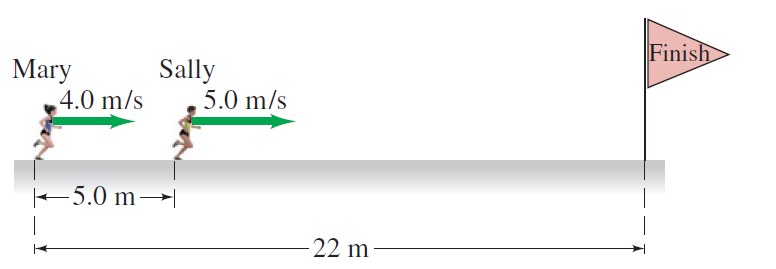
Mary and Sally are in a foot race (Fig. 2–39). When Mary is 22 m from the finish line, she has a speed of 4.0 m/s and is 5.0 m behind Sally, who has a speed of 5.0 m/s. Sally thinks she has an easy win and so, during the remaining portion of the race, decelerates at a constant rate of 0.40 m/s2 to the finish line. What constant acceleration does Mary now need during the remaining portion of the race, if she wishes to cross the finish line side-by-side with Sally?

Given data

  • Mary’s initial speed: vM = 4.0 m/s
  • Sally’s initial speed: vS = 5.0 m/s
  • Mary’s distance to the finish: 22 m
  • Sally is 5.0 m ahead of Mary.
  • Sally’s acceleration: aS = −0.40 m/s2
  • Mary’s required acceleration: aM = ?

Step 1: Find Sally’s remaining distance

Mary is 22 m from the finish line, and Sally is 5.0 m ahead. Therefore, Sally has only

sS = 22 − 5 = 17 m

Step 2: Calculate the time Sally takes to reach the finish

Since Sally decelerates uniformly, use the equation of motion:

s = ut + ½at2

Substitute Sally’s values:

17 = 5t + ½(−0.40)t2

17 = 5t − 0.20t2

0.20t2 − 5t + 17 = 0

Using the quadratic formula:

t = (5 ± √(25 − 13.6)) / 0.40

t = (5 ± √11.4) / 0.40

t ≈ 4.06 s or 20.94 s

Sally reaches the finish line at the first time, so the physically relevant time is:

t = 4.06 s

Step 3: Calculate Mary’s acceleration

To finish side-by-side, Mary must cover 22 m in the same time, 4.06 s. Her initial speed is 4.0 m/s.

Apply the equation of motion:

s = ut + ½at2

22 = 4(4.06) + ½aM(4.06)2

22 = 16.24 + 8.24aM

8.24aM = 5.76

aM = 5.76 / 8.24

Using the unrounded value of the time gives aM ≈ 0.698 m/s2.

Final Answer

aM ≈ 0.70 m/s2

Mary must accelerate at approximately 0.70 m/s2 in the forward direction.

Key idea

When two runners must finish together, first calculate the finishing time of the runner whose motion is known. Then use that same time and the other runner’s distance and initial speed to determine the required acceleration.

7

Police Car Overtaking a Speeder

Question (III)

An unmarked police car traveling a constant 95 km/h is passed by a speeder traveling 135 km/h. Precisely 1.00 s after the speeder passes, the police officer steps on the accelerator; if the police car’s acceleration is 2.60 m/s2, how much time passes before the police car overtakes the speeder (assumed moving at constant speed)?

Given data

  • Initial police car speed: 95 km/h
  • Speeder’s constant speed: 135 km/h
  • Police reaction time: 1.00 s
  • Police car’s acceleration: 2.60 m/s2
  • Police car’s initial acceleration period begins after 1.00 s.

Step 1: Convert speeds into m/s

Use the conversion formula:

Speed in m/s = Speed in km/h × 5/18

For the police car:

uP = 95 × 5/18

uP = 26.39 m/s

For the speeder:

vS = 135 × 5/18

vS = 37.50 m/s

Step 2: Find the initial lead of the speeder

During the first 1.00 s, the police car continues at its constant speed while the speeder moves faster. Therefore, the speeder gains a distance equal to the difference between their speeds multiplied by the reaction time.

Gap = (vS − uP)t

Gap = (37.50 − 26.39)(1.00)

Gap = 11.11 m

Step 3: Write the equations of motion

Take the position where the speeder passes the police car as x = 0 at t = 0. Let t be the time measured from that instant.

For the speeder, which moves at constant speed:

xS = 37.50t

For the police car, the motion has two stages. During the first second, it moves at constant speed. After that, it accelerates.

For t ≥ 1.00 s, its position is

xP = uPt + ½a(t − 1)2

The acceleration acts only during the time (t − 1) after the officer presses the accelerator.

Step 4: Find when the police car catches the speeder

At the overtaking instant, both vehicles have the same position:

xP = xS

26.39t + ½(2.60)(t − 1)2 = 37.50t

26.39t + 1.30(t − 1)2 = 37.50t

1.30(t − 1)2 = 11.11t

1.30t2 − 13.71t + 1.30 = 0

Applying the quadratic formula gives two mathematical roots. The smaller root is less than 1.00 s, before the police car begins accelerating, so it is not physically valid for this stage. The valid root is approximately

t ≈ 10.45 s

Step 5: Interpret the time

The value t = 10.45 s is measured from when the speeder first passes the police car. The officer waits 1.00 s before accelerating.

Time after acceleration begins = 10.45 − 1.00

9.45 s

Final Answer

From the moment the speeder passes, the police car overtakes it after approximately

10.45 s

Equivalently, it takes approximately 9.45 s after the police officer begins accelerating.

Key idea

When one vehicle reacts after a delay, account for the initial interval separately. Then use the equations of motion for the accelerating vehicle and the constant-speed vehicle, and equate their positions to find when they meet.

←
→